
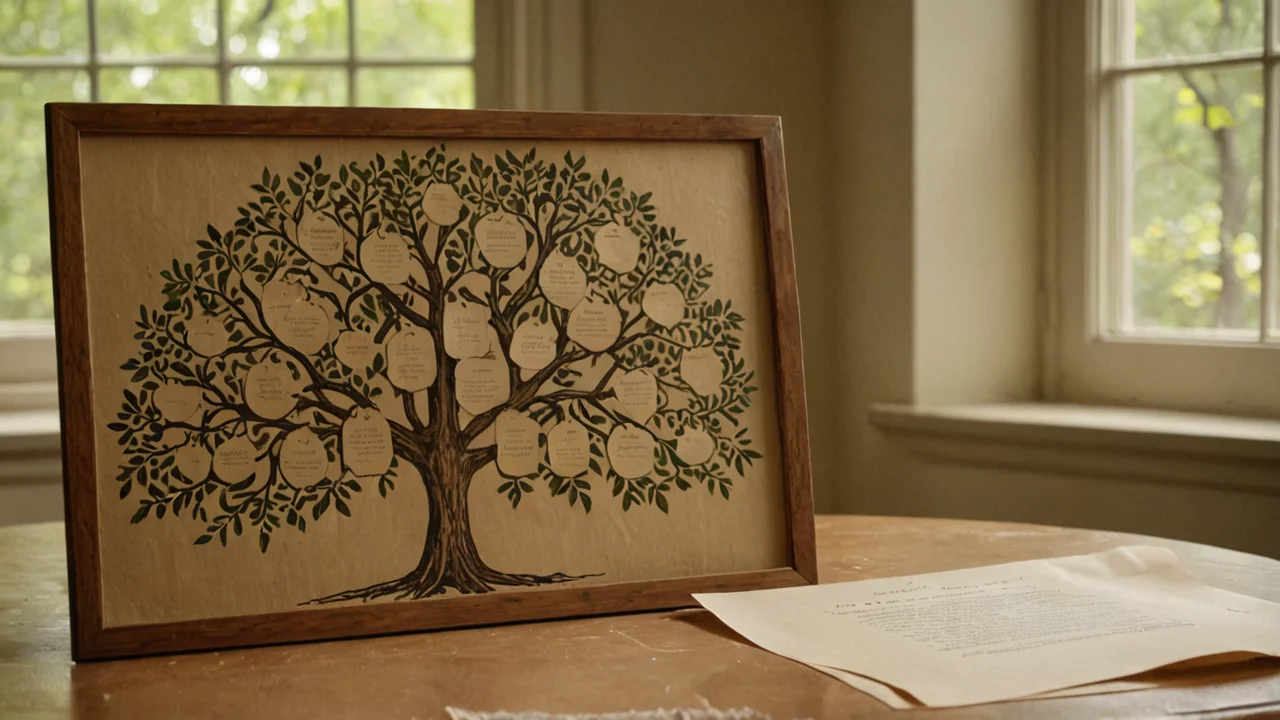

Ancestral history is the branch of genealogy that works backwards from a known person to their direct forebears, generation by generation, and it is built on one discipline: every generation you add has to be documented before you move past it. The pedigree chart is the shape of that work — a chart that shows direct ancestors generation by generation, starting with the person at the center — and everything else on this page is about how to fill it honestly, in what order, and what it costs you in time, money, and dead ends.
What ancestral history actually covers, and what it leaves out
Ancestral history follows the direct line only: parents, grandparents, great-grandparents, straight back. It does not follow siblings, aunts, uncles, or cousins unless one of them is the only route to a document about your ancestor. A family tree is a diagram of family relationships that can include ancestors, descendants, and other relatives; a pedigree chart is the narrower thing, direct ancestors only. Confusing the two is the most common reason a beginner's research stalls — they start filling in every sibling of every great-grandparent, the tree balloons sideways, and the direct line stays three generations deep and unproven.
The direct line is narrower but harder per person. Collateral relatives — siblings of your ancestors — are often easy to find because they stayed put, married locally, and left wills and land records in the same county. Your direct ancestor may be the one who moved. That is why the practical advice is to research collateral lines as tools: a brother's probate record may name the sister who vanished from the county, and a sister's marriage bond may give the maiden name you could not otherwise prove. Use them, but do not let them become the project.
The cost of staying narrow is that you will hit a generation where no direct document survives and the only way through is a sideways move into a sibling's records. Budget for that. The cost of going wide is worse: a tree with hundreds of names and no citations, which is a liability rather than an asset, and which someone in your family will eventually copy wholesale onto a genealogy website without checking any of it.
How the generations are numbered, and what "removed" means
"Once removed" means the two people are one generation apart; "twice removed" means two generations apart. A first cousin once removed is your first cousin's child, or your parent's first cousin — one generation away from being first cousins. A first cousin twice removed is two generations removed in either direction. The "removed" is not a measure of closeness or affection; it is a count of generational distance, and it works identically up and down.
The arithmetic that makes it click: find the common ancestor, count the generations from that ancestor down to each of you. Same number on both sides — you are first cousins (both one generation down), second cousins (both two), and so on. Different numbers — the smaller number names the cousinship, the difference is the removal. Your grandfather and someone else's great-grandfather are the same person's children and grandchild; you and that person are one generation apart, so first cousins once removed.
This matters practically because funeral-home notices, obituaries, and old letters use these terms loosely, and families use them wrongly. A "cousin" in a 19th-century letter may be a first cousin, a second cousin, or a completely unrelated neighbor addressed affectionately. Do not build a relationship on the word alone; build it on the generation count from a documented common ancestor. Where the count cannot be established, record the relationship as stated and flag it as unproven rather than assigning it.
| Relationship | Generations from common ancestor | Difference |
|---|---|---|
| First cousins | One on each side | None |
| First cousin once removed | One and two | One generation |
| First cousin twice removed | One and three | Two generations |
| Second cousins | Two on each side | None |
The research sequence: what to do first, second, and third
Work from the known to the unknown, and work backwards in time, never forwards from a distant ancestor toward yourself. Start with what is in the house: birth certificates, marriage licenses, military discharge papers, baptismal cards, family bibles, photograph backs, and the funeral-home register from the last family death. These are free, they are accurate, and they establish the chain of identity that every later record must match. Skipping this step and jumping straight to an online search for a great-great-grandparent is the single most common failure, because you end up researching a person with the right name and the wrong family.
Then move to civil registration and census records in that order, on paper and online, for the place your family actually lived. County courthouses hold deeds, wills, probate files, and marriage bonds, and a large share of them are not digitized; the ones that are often sit behind a subscription. Church records fill the gap before civil registration, and they are usually held by a diocesan archive or a local historical society rather than a national database. Only after those are exhausted should you consider DNA testing, and it is genuinely a last resort for a specific brick wall, not a starting point — a test tells you that someone is related, never how, and the how is the entire product.
The honest sequence costs time rather than money for the first several generations. The expensive part comes later, when the records are in another country, in another language, on microfilm, or in a courthouse that wants a fee and a written request and takes weeks to answer. That is the point at which many people pay a professional researcher in the records' home country, which is usually cheaper and far more accurate than paying a large subscription service to guess.
Documentation standards: what counts as proof
A fact belongs on your pedigree chart only when a record supports it, and a record supports it only when the identity matches across more than a name. Names repeat relentlessly within families — a man names his son after himself, his brother, and his dead infant son in the same parish — so match on a combination: name plus approximate birth year plus place plus spouse plus parents' names. When two candidates both fit, you have a hypothesis, not an ancestor, and it should be marked as such rather than merged into the tree.
Record the source for every fact at the moment you enter it, including the call number, microfilm reel, page number, or URL, and the date you looked. A citation you reconstruct a year later from memory is worth very little; the specific page reference you wrote down at the time is what lets you or anyone else re-verify. Transcribe documents word for word rather than summarizing them, especially wills and deeds, where a single phrase about "my eldest son" or "the land adjoining" carries the whole evidentiary weight.
Distinguish primary information from secondary. A death certificate's date and place of death are usually reliable — the informant was present or nearby. The same certificate's statement of the deceased's parents' names is secondary, supplied by a grieving relative who may be guessing, and the mother's maiden name on a death certificate is one of the most frequently wrong facts in genealogy. Prefer records created at the time of the event, by someone with direct knowledge, and treat everything else as corroboration. Where records conflict, write down both versions and the reason you favor one; do not silently delete the inconvenient one.
Where the paper runs out, and what to do there
Every line eventually hits a wall, and the wall is usually one of three things: a record series that was never kept, a record series that was destroyed, or a name change that broke the chain. Civil registration began at different dates in different places, so there is a hard boundary before which you must rely on church records, and church records themselves have gaps from fire, flood, war, and simple neglect. When the wall is a destroyed series, no amount of searching will fix it; the answer is to find a substitute source that records the same fact — tax lists, land deeds, militia rolls, poor-law records, or a neighbor's will that names your ancestor as a witness or beneficiary.
When the wall is a name change, work on the family rather than the individual. Immigrants anglicized surnames at naturalization, at enlistment, and at the first census after arrival, often inconsistently across the same family's records. Search every plausible spelling variant and every phonetic equivalent before concluding the record does not exist; indexers have transcribed the same name half a dozen ways. When the wall is simply that the records are in a language and script you cannot read, that is the moment to hire a researcher who can, and it is money well spent compared with months of guessing at a film.
DNA is the tool for a wall that is a broken biological link rather than a missing document — an adoption, a non-paternity event, a foundling, a family story that does not match the paper. It works, but it works slowly and indirectly: you get matches, then you build trees for the matches, then you find the common ancestor, and that is a project measured in months rather than an afternoon. It is also the wrong tool for a missing 18th-century parish register, where no living person's DNA carries information that the surviving paper does not already imply.
What a defensible ancestral history costs, and when to stop
The realistic cost of a well-documented direct line is mostly time, plus targeted spending: certified copies of vital records, courthouse and archive fees, microfilm or digitization charges, occasional travel to a county courthouse or diocesan archive, and a professional researcher's hourly rate for the records you cannot reach. Subscriptions to large record databases are convenient but not the main expense, and paying for one does not substitute for the courthouse visit — much of the material that settles a difficult identification is still only on paper in the county where the family lived.
Set a stopping rule before you start, or the project will run indefinitely. A reasonable one: research each generation until you have a documented birth or baptism, a documented marriage, and a documented death or burial, with the identity matched on at least two independent facts, and then move back one generation. Stop when you reach a generation where the surviving records cannot support that standard, record what you know and what you suspect in separate places, and leave it. A pedigree chart with gaps honestly marked is more useful to the next researcher than one filled with confident guesses, because the gaps tell them exactly where the work remains.
The trade-off is that a strict standard feels slow, and it is. The alternative — accepting a name because it appears in someone else's online tree — feels fast and produces a chart that will not survive contact with a single original document. The people who get furthest are not the ones with the biggest trees; they are the ones who can produce, for any name on the chart, the specific record and page that put it there.
Filling a pedigree chart without losing the plot
A pedigree chart holds one person per position and no room for doubt, which is why you should keep a working file alongside it rather than treating the chart as the research record. The chart is the output; your notes, transcriptions, and flagged hypotheses are the workshop. Every time you enter a name on the chart, the supporting citation should already exist in the file. If it does not, the name is not ready for the chart.
The most common practical problem with pedigree charts is the female line. A woman's maiden name disappears at marriage in most civil records, so her position on the chart often stays blank for years while the male lines fill in around her. Expect that asymmetry and do not read it as failure. It usually resolves through a marriage record, a father's will, or a sibling's baptism, and it frequently resolves last.
Cousin terms in old documents, and why they mislead
Obituaries and family letters routinely use "cousin" as a term of affection rather than a statement of relationship, so treat the word as a lead and never as a conclusion. The generation count from a documented common ancestor is the only thing that establishes a cousinship; without that count you have a claim, not a relationship.
Where a letter or notice does specify a removal, record it exactly as written and note who wrote it. A first cousin twice removed named in a funeral notice is two generations from the deceased, which narrows the search considerably even when the name itself is spelled inconsistently. That narrowing is the real value of the terminology — it tells you where to look in the records, not who the person was.