

Genealogical research is the discipline of building a defensible account of who someone's ancestors were, and it works by working backward from a known person, one generation at a time, proving each link before moving to the next. The three decisions that determine whether your research holds up are: whether you are recording identity or merely names, whether you are searching original records or derivative indexes, and whether you are documenting your reasoning as you go. Get those three right and the tree survives scrutiny; get them wrong and you will eventually have to demolish years of work.
Working backward is not a stylistic preference, it is the method
You start with yourself or with the most recent person you can document, and you move one generation back only after the current one is established. This is the opposite of how most people instinctively research — they want to jump straight to the famous ancestor, the immigrant, the Revolutionary War soldier — and that instinct is the single most common reason family trees contain errors that take a decade to discover.
The reason backward research works is that every generation you go back, the pool of possible people grows and the records thin out. A birth certificate names parents; a census names a household; a will names children, sometimes in order. Each record type is a link in a chain, and the chain only holds if each link is forged separately. If you start with the 18th-century ancestor and work forward, you are guessing at which of several plausible John Smiths is yours, and you have no way to test the guess until you have reconstructed the intervening generations anyway — at which point you have done the work twice.
The practical shape of it: for each person, you want a birth or baptism, a marriage, a death or burial, and at least one record that places them in a household or community at a specific time. Census returns are the workhorse here because they place people in households and locations at a known date, but they are also the most error-prone, because the person answering the enumerator was often a spouse, a child, or a neighbor, and ages drift between decades. Treat every census age as approximate and every birthplace as a claim rather than a fact.
What this costs you is time. Backward research is slow, and the temptation to skip a generation when a record is stubborn is enormous. The discipline is to leave the gap open, mark it as unresolved, and move sideways into siblings and collateral lines — a sibling's baptism record often names the same parents and confirms a family group when the direct ancestor's own record is missing. That sideways move is not a detour; it is one of the most reliable ways to break through a brick wall.
Original records, derivative indexes, and why the distinction matters more than anything else
An original record was created at or near the event by someone with knowledge of it: a parish register entry, a county marriage return, a probate file, a ship manifest, a military pension application. A derivative record is anything made from an original later — a transcription, an abstract, a compiled genealogy, an online index, a printed county history. Derivative sources are enormously useful for finding originals, and they are not evidence of anything until you have checked them against the original or against a second independent derivative.
The failure mode is specific and recognizable. You find a name in an online index, the index says the father is "John," you attach it to your tree, and three years later you discover the index abstracted the wrong column or the transcriber misread an abbreviation. Indexes are made by people and by machines, both of which err, and the errors are not random — they cluster around hard-to-read handwriting, unusual names, and damaged pages. A name like "Mehitable" or a surname beginning with a flourish will produce a crop of wrong hits in any index you search.
The rule that follows from this: use indexes to locate records, then obtain the record. If the original is a microfilm you can order, order it. If it is a digitized image behind a subscription, open the image and read it yourself rather than trusting the search result. If the original is only available at a county courthouse or a state archive, write down what you need and plan a visit or a written request — many archives will do a lookup for a fee, and the fee is almost always worth paying compared with the cost of building on a bad transcription.
The trade-off is real. Original records are slower, often illegible, sometimes inaccessible, and occasionally genuinely lost to fire or flood. There are counties whose courthouse records burned, and no amount of diligence will recover them. In those cases you are working from derivatives and from substitutes — tax lists, land deeds, church records, newspaper notices — and the honest thing is to say so in your notes: this link rests on a derivative source because the original is unavailable. That sentence is worth more to a future researcher than a confident assertion resting on nothing.
What a pedigree chart shows, and what it deliberately hides
A pedigree chart shows direct ancestors generation by generation, starting with the person at the center, and it is the most misleading document in genealogy if you mistake it for the whole picture. Everything on it is a direct line — parent, grandparent, great-grandparent — and everything else is absent: siblings, aunts, uncles, cousins, second wives, children who died young, the family that moved two counties over and vanished from the record.
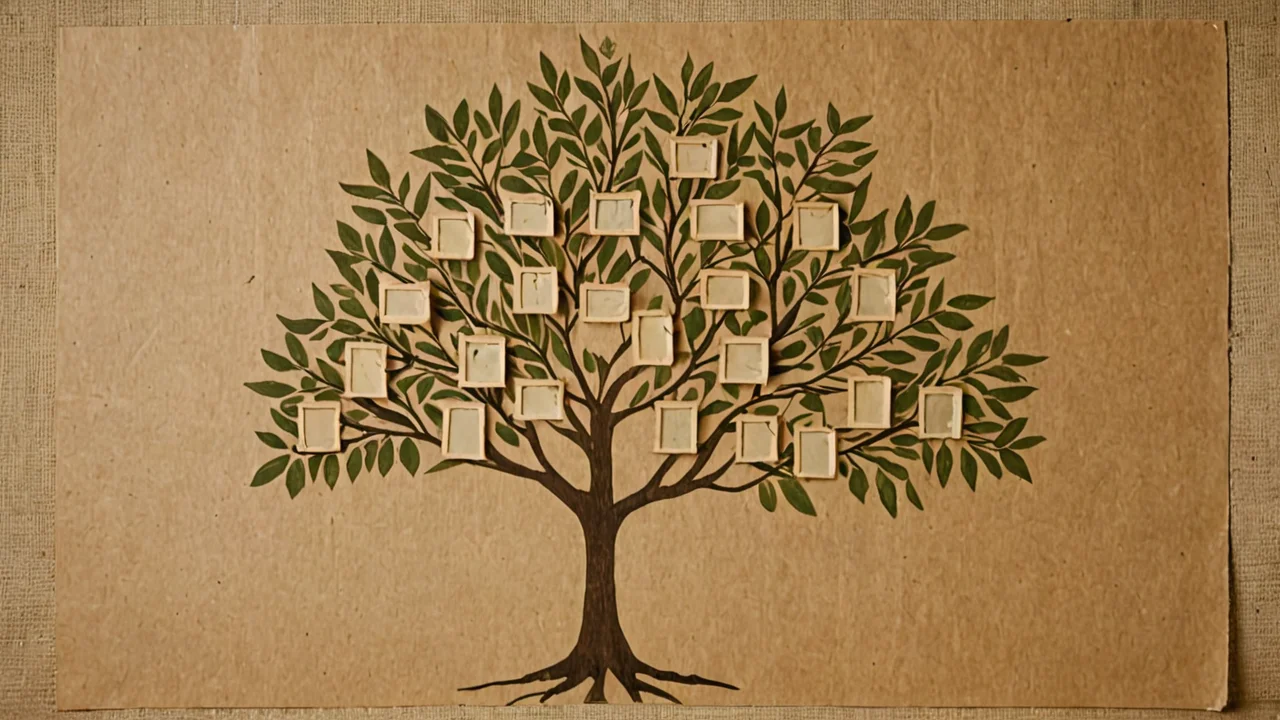
A family tree, by contrast, is a diagram of family relationships that can include ancestors, descendants, and other relatives. The distinction is not cosmetic. The pedigree chart is a summary you produce at the end; the family tree is the working structure you build as you go, and it should include the collateral lines because that is where the evidence lives. If your working file is only a pedigree, you have stripped out the people who appear as witnesses on deeds, as godparents at baptisms, as bondsmen on marriage bonds, and as heads of household on the census page next door. Those people are your best evidence for identifying the direct ancestor, and a chart that excludes them has thrown that evidence away.
There is also a naming problem the charts make worse. Cousin relationships are described by generation distance, and the terminology is precise: a first cousin once removed is a cousin relationship where the two people are one generation apart — one generation removed from being first cousins — and a first cousin twice removed is a relationship where the two people are two generations apart. On a pedigree chart these people either do not appear at all or appear on a line that makes the generational distance hard to read, which is exactly how the same person gets entered twice, once as a cousin and once as a great-aunt, in two different branches of the same file. If you keep collateral relatives in the working tree with their relationship labels spelled out, you catch those duplicates before they turn into a merge you cannot undo.
Documenting as you go, or paying for it later
Record the source at the moment you record the fact, in enough detail that you or a stranger could find the same record again without asking you a question. That means the repository, the record series, the volume or film number, the page or entry number, and the date you looked. "1850 census, Ohio" is not a citation. "1850 U.S. census, Muskingum County, Ohio, population schedule, Falls Township, p. 412 (stamped), dwelling 88, family 91, John Smith household; NARA microfilm M432, roll 715" is a citation, and it will still make sense in twenty years when you have forgotten which website you were on.
The reason to do this immediately rather than later is not virtue, it is arithmetic: you will look at hundreds of records, and the details of any given one evaporate within days. The page number you were sure you would remember is gone by the weekend. Researchers who postpone citation end up re-ordering microfilm to re-find things they already found once, and the cost of that is measured in afternoons.
Alongside the citation, keep a short note on what the record says versus what you conclude from it. A baptism record that names the child and the father but not the mother is evidence of a father-child relationship and says nothing about the mother's identity; if your note reads "baptism of Mary, daughter of John, mother unknown," you will not later mistake your own inference for the record's content. This matters most with ages and dates, which are routinely derived rather than stated — a death certificate's birth date is informant-supplied and frequently wrong by years, and a headstone age at death is arithmetic performed by a stonecutter.
The cost of this discipline is that it roughly doubles the time per record. The return is that you never have to redo a line, and that when you hit a conflict — two records giving different birth years for the same person — you have the citations in front of you to weigh which source was closer to the event and which informant had reason to know.
Testing a conclusion before you accept it
Every genealogical conclusion should survive an attempt to disprove it, and the standard test is to ask what else the records would look like if you were wrong. If you believe John Smith of Ross County is the son of William Smith, then William's household should show a male of John's age in the census years before John's marriage, William's will or probate should mention him or conspicuously omit him, and the naming patterns of John's own children should be consistent with the family — though naming patterns are weak evidence on their own and should never carry a conclusion by themselves.
The commonest way a wrong conclusion survives is that the researcher stops looking once a record fits. A record that fits is not the same as a record that is the only fit. Two men of the same name in the same county, born within a few years of each other, will both appear in the indexes, and the one that surfaces first is not necessarily yours. Before attaching a record, ask whether you can distinguish your person from the other candidate using something independent — a middle initial, a wife's maiden name, a specific occupation, a land description, a migration destination.
Where the evidence is genuinely thin, say so and label the conclusion as probable or possible rather than certain. Genealogical writing has a rough hierarchy for this and it is worth using: certain when an original record states the fact directly, probable when several independent sources point the same way without a direct statement, possible when a single derivative source or an inference supports it. A tree that distinguishes these three is more useful than one that presents every link with the same flat confidence, because the next researcher knows exactly where to dig.
Records by jurisdiction, and why the date of the event decides where you look
Where a record exists depends on when and where the event happened, and the single most useful thing you can learn early is the record-keeping timeline for each place you are working. Civil registration of births, marriages, and deaths is a modern development in most of the English-speaking world; before it, the church kept the register, and before the church, you are working from tax rolls, land records, probate, and military records. A death that occurred before civil registration will not have a death certificate, no matter how many databases you search, and the time spent searching for one is time you could have spent in the parish register.
The same logic applies at the county level. Marriage records are usually kept by the county and survive better than birth records, because they were recorded at the time of the license or bond and the fees created an incentive to keep them. Probate records are the richest single source for family structure, because a will or an intestate estate file names heirs and their relationships, and estate inventories and accounts name neighbors and creditors who are often kin. Land deeds place people in a specific location at a specific date and are the standard tool for distinguishing two men of the same name — one sells, the other buys, and the chain of title tells you which is which.
What goes wrong is jurisdictional change. Counties split, boundaries move, and a record created in a place that no longer exists may now sit in a courthouse two hundred miles away or in a state archive. Before you conclude a record does not exist, find out what jurisdiction covered the place at the date of the event, and check the parent county as well as the present one. This is dull work and it is the difference between a brick wall and a solved problem more often than any search technique.
The honest limit of all of this is that some lines cannot be pushed further with the records that survive. When you have exhausted the originals, checked the derivatives, worked the collateral lines, and tested the conclusion against alternatives, the correct move is to document what you have, state the open question plainly, and leave it for someone with access to a record you cannot reach. That is not failure; it is the normal condition of genealogical research, and a well-documented wall is far more valuable to the next person than a wall papered over with a guess.