
A fictional lineage is a family line you construct deliberately — for a novel, a tabletop campaign, a historical reenactment persona, or a genealogy puzzle — and the first decision is always the same: whether you are building a pedigree chart or a family tree. A pedigree chart shows direct ancestors generation by generation, starting with the person at the center; a family tree is a diagram of family relationships that can include ancestors, descendants, and other relatives. Pick the pedigree and you get depth with no width — one clean line back through time. Pick the tree and you get the cousins, the second marriages, the siblings who married into each other's families, and every complication that makes a lineage feel real. Most people need both, but in a fixed order, and the order matters more than the software.
Start with the pedigree spine, not the branches
Build the direct line first, from your central character back through every generation, and do not add a single sibling until that spine is complete and internally consistent. A pedigree chart is the cheapest structure to keep honest: each generation is a row, each person has exactly two parents, and any contradiction — a mother giving birth at an impossible age, a father who dies before his child is born, two generations occupying the same decade — shows up immediately because there is nowhere for it to hide. The moment you start with the branches instead, you are maintaining dozens of dates at once before you have checked whether the central line even works.
The practical sequence is to fix your anchor person's birth year first, then work backward in whole generations, assigning each generation a plausible span before you name anyone. Naming comes last because names carry associations that pull you toward story decisions you haven't earned yet. Once the spine holds, each generation gets a birth range, a death range, a place, and a cause — four fields, no more. Resist the urge to write biography at this stage. The spine's job is to be structurally sound, and every paragraph of backstory you attach to a person you may later delete is wasted work.
The cost is time up front and a certain sterility: a pedigree alone produces a lineage that reads like a wire diagram, with no texture. That is the point. If you are building a lineage for a puzzle or a plausibility check rather than for narrative, the pedigree spine may be all you ever need, and adding branches will actively make the result worse by diluting the one thing you were testing.
Removed cousins are a generation count, nothing else
The "removed" in a cousin relationship measures the gap in generations between the two people, and that is the entire rule. Once removed means the two people are one generation apart; twice removed means they are two generations apart. The ordinal in front — first, second, third — measures something different: how far back you have to go to find the shared ancestor. First cousins share grandparents. Second cousins share great-grandparents. The two numbers move independently, which is why "first cousin once removed" describes a pair who share grandparents but sit one generation apart, and "first cousins twice removed" describes a pair who share grandparents but sit two generations apart.
In practice this means your character's mother's first cousin is the character's first cousin once removed — one generation removed from the character, sharing the character's grandparents with the mother. The same person is a plain first cousin to the mother. This is where fictional lineages most often break: writers assign a relationship label from one character's point of view and then use it from another's, and the tree quietly becomes wrong. The fix is mechanical. Write the shared ancestor at the top, count generations down each side, and take the smaller count as the ordinal and the difference as the removal. If the difference is zero, there is no removal at all.
The trade-off is that accurate labels are often clumsy in dialogue. Nobody says "my first cousin twice removed" in casual speech; they say "my cousin" or "my grandmother's cousin" and let the listener work it out. Use the precise term in your working notes and the loose one in the text, but keep the notes authoritative — the moment you start improvising labels in prose, the structure drifts and you will contradict yourself three chapters later.
Marriage between branches is where lineages earn their realism
Once the pedigree spine is stable, the single most effective addition is a marriage between two branches of the same tree, because it forces you to resolve the structure rather than describe it. Cousin marriage, a second marriage into a family that already married in, two siblings from one family marrying two siblings from another — each of these collapses the tidy two-parents-per-person rule and makes you decide exactly how the lines connect. That decision is the work. A tree with one such marriage is more convincing than a tree with forty generations of strangers.
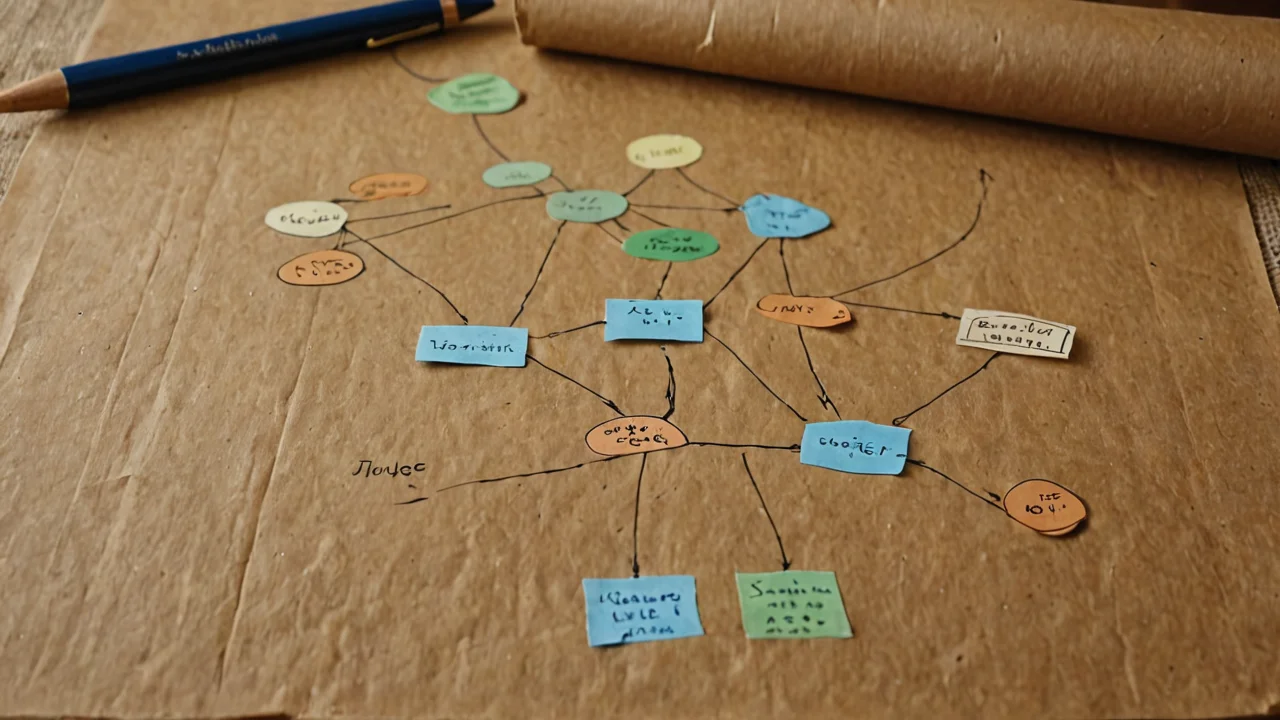
Do it on paper or in a tool that draws lines rather than lists names, because the failure mode is invisible in a text document: you will have two people who are simultaneously second cousins and step-siblings and you will not notice until a reader points out that a character has three grandmothers. Keep a separate note that names every pair of people related through more than one route, and check it every time you add a person to either branch.
The honest cost is complexity debt. Every cross-branch marriage roughly doubles the number of relationships you have to keep straight, and past two or three of them, most people cannot hold the tree in their head and must consult the diagram for every scene. If your lineage exists to support a fast-moving story rather than to be examined, one such marriage is plenty; more will slow you down more than they add.
Dates, places, and causes are the load-bearing details
A fictional lineage becomes believable through three fields per person — a birth year, a death year, and a place — and through the gaps between them being consistent across the whole tree. The discipline is arithmetic, not research: a woman's children must fall inside her plausible childbearing years, siblings must be spaced at intervals that permit each birth, and a person cannot die in a place they never travelled to. Check these mechanically, generation by generation, before you write a word of narrative. Most implausible lineages fail on spacing, not on names.
Places do more work than dates for texture. A lineage that stays in one town for six generations reads as rooted; one that moves every generation reads as restless; one that moves once, decisively, and then stays reads as a story. Decide the movement pattern for the whole line before you assign individual locations, because a single character who relocates for no structural reason is the detail readers notice as arbitrary. Causes of death follow the same logic: a line where everyone dies old is a line with no drama, and a line where everyone dies young has no living relatives to inherit anything.
What this costs is flexibility. Once you have fixed dates and places across several generations, changing the anchor person's birth year ripples through everything and can take hours to repair. That is precisely why the spine comes first — a late structural change is expensive, and the arithmetic check is what tells you whether the structure is sound before you build on it.
Naming conventions carry more weight than you expect
Repeating given names across generations is the fastest way to make a lineage feel real and the fastest way to make it unreadable. The historical pattern — a child named for a grandparent, a second son named for the mother's father, a daughter named for a deceased sister — produces exactly the tangle of identical names that real family trees contain, and it forces you to decide how your reader will tell them apart. That decision is worth making early: a suffix, a distinguishing middle name, or an occupational tag in your notes, applied consistently from the first generation.
The failure mode is subtler than confusion. If every generation names a son after the father, you have created a chain of people whose identities blur, and any scene involving two of them must work around the ambiguity every time. Some writers lean into this deliberately and make the inheritance of the name a plot point; most do not, and simply end up with a tree where four people share a name and none of them has a distinct voice. Decide which you are doing before the second generation.
The trade-off is authenticity against clarity. A lineage with no name repetition looks modern and slightly sterile; one with heavy repetition looks period-accurate and is harder to write. Naming conventions also interact with the cousin problem above — two first cousins twice removed who share a given name is a scene you will have to write carefully or avoid entirely.
When to stop building and start writing
Stop expanding the lineage when the structure passes three checks: the pedigree spine is complete and arithmetically consistent, every cross-branch marriage is documented, and every person has a birth year, death year, and place. Beyond that point, additional generations add maintenance work without adding anything a reader will encounter. A lineage is scaffolding, and scaffolding that has become more elaborate than the building is a sign you have stopped working on the thing you set out to make.
The signal that you have gone too far is specific: you find yourself adding a person solely to make the tree symmetrical, or naming a great-aunt who will never be mentioned, or resolving a date conflict in a branch that has no bearing on any scene. At that point the tree has become its own project. That is a legitimate thing to want — some people build fictional lineages for the pleasure of the structure itself, and a pedigree chart with no story attached is a perfectly good object — but be honest about which activity you are doing, because the two have different stopping rules.
If the lineage is for a story, the stopping point is when the structure stops constraining the scenes. If it is for a puzzle, a campaign, or a plausibility exercise, the stopping point is when the checks pass and further detail cannot be wrong. Either way, the order is the same: spine, then removals, then cross-branch marriages, then dates and places, then names — and each stage is cheaper to redo than the one after it.
Drawing the tree so the removals are visible
Draw every generation on its own horizontal row, oldest at the top, and the removal count becomes something you can read off the page rather than calculate. Two people on the same row share an ordinal with no removal; one row apart and they are first cousins once removed if the shared ancestor is a grandparent; two rows apart and they are first cousins twice removed. Layout does the arithmetic for you, and a mislabelled relationship shows up as two people sitting on rows that contradict the label. Software that auto-arranges by generation gives you this for free; a text outline never will.
The trade-off is that a strict row-per-generation layout gets wide fast once you add siblings and second marriages, and wide trees are hard to read on a screen. Most drawing tools let you collapse a branch to a single node without deleting it, which keeps the spine visible while hiding the width. Do that rather than trimming people out — a collapsed branch can be reopened when a scene needs it, and a deleted one takes its cross-branch marriages with it.
A shared ancestor is one node, not two
The commonest structural error in a fictional tree is entering the same ancestor twice — once under each descendant line — which quietly splits one family into two unrelated ones and makes every removal count downstream wrong. A shared grandparent is a single person with two child lines descending from them; the tree should look like a fork, not two parallel columns that happen to carry the same name. If your tool asks you to create the ancestor separately for each branch, stop and find the merge or link function instead.
Check for it by counting: every person in the tree except the earliest generation should have exactly two parents recorded, and any person appearing more than once in your notes is either a duplicate entry or a genuine cross-branch marriage, and you should be able to say which. The duplicate is the harder one to catch because the tree still looks plausible — the labels read correctly from each side in isolation. It only falls apart when a character refers to someone as a cousin and the diagram says they share no ancestor at all.